

How to Bond Plastic to Metal Surfaces: 7 Proven Tips
Last Updated: November 4, 2026
Quick Summary
Successful bonding plastic to metal depends on identifying your plastic first, then matching the adhesive to both surfaces and the conditions the joint will face. Clean and abrade the metal, prepare the plastic appropriately, and design the joint so loads pull along it rather than peeling away. Test a sample joint before trusting the finished bond.
- Low-energy plastics such as polyethylene and polypropylene resist most glues without a specialist primer.
- Epoxy fills gaps and handles load but can crack on parts that flex.
- 3M VHB tape reaches around 90% of its bond strength after 24 hours.
- Adhesives handle shear and compression far better than peel loads.
- Just Tape stocks 3M VHB tape rolls from £5.95 with free Royal Mail 48 shipping on UK orders over £20.
Table of Contents
- Why Plastic-to-Metal Bonds Fail (and How to Get Them Right)
- Identify Your Plastic Before You Choose an Adhesive
- The Best Glue for Metal to Plastic: Comparing Your Options
- How to Stick Plastic to Metal: A Step-by-Step Preparation Workflow
- Double-Sided Tape for Plastic to Metal: When It Beats Liquid Adhesive
- Application, Clamping and Cure Times Explained
- Joint Design, Load Direction and Testing Your Bond
- Ordering the Right Adhesive for Your Project
- Frequently Asked Questions
Why Plastic-to-Metal Bonds Fail (and How to Get Them Right)
Most failed plastic-to-metal joints do not fail because of bad glue. They fail because of bad preparation, mismatched materials, or a load pulling in the wrong direction. A common pattern is a joint that pops apart after a strong adhesive is used, with the product often blamed for what is really a preparation or material mismatch. In practice, bonding plastic to metal is a process, not a single product.
A useful definition: bonding plastic to metal is the process of joining two dissimilar materials with an adhesive or tape, where success depends on matching the adhesive to both surfaces and to the conditions the joint will face. Dissimilar materials expand at different rates, so a rigid, brittle adhesive can crack under temperature change.
Below, we break down seven proven tips, from identifying your plastic to testing the finished joint. Get these right and a modest adhesive will outperform an expensive one applied badly.
Identify Your Plastic Before You Choose an Adhesive
The single biggest mistake is choosing an adhesive before knowing the plastic. Plastics behave very differently: some are easy to bond, others resist almost everything.
- Hard plastics such as rigid PVC, ABS and polycarbonate bond well with most structural adhesives.
- Clear plastic often shows marks, so choose a clear adhesive or tape.
- Flexible plastics need an adhesive that stays flexible, or the joint cracks when the part bends.
- Low-energy plastics such as polyethylene and polypropylene resist most glues without a specialist primer.
Check the recycling symbol or the manufacturer's data sheet. If you cannot identify the plastic, test a small hidden area first. Our guide to high strength mounting tapes for plastic goes deeper into matching tape to plastic type.
The Best Glue for Metal to Plastic: Comparing Your Options
There is no single best glue for metal to plastic. The right choice depends on gap, load and the conditions the joint will face in service. Matching the adhesive to the environment matters as much as matching it to the materials. Here is how the main families compare, followed by guidance on selecting by use conditions.
| Adhesive | Best for | Cure time | Watch out for |
|---|---|---|---|
| Epoxy (two-part) | Load-bearing joints, gap filling | 5 min to 24 hrs | Rigid, can crack on flexing parts |
| Cyanoacrylate (super glue) | Small, close-fitting parts | Seconds to minutes | Brittle, poor gap filling |
| MMA (acrylic) | Large panels, mixed materials | 10 to 30 min | Strong odour, needs ventilation |
| Double-sided tape | Flat, clean surfaces, light loads | Immediate grab | Needs smooth, flat contact |
Epoxy Glue for Plastic and Metal
Epoxy glue for plastic and metal is a two-part adhesive that cures hard when resin and hardener are mixed. It fills small gaps and handles load well. It is the safest default for structural repairs where parts fit loosely.
The trade-off is rigidity. On a part that flexes or sees sharp temperature swings, a hard epoxy can crack. For those jobs, an MMA or a flexible tape suits better.
Cyanoacrylate and MMA Adhesives
Cyanoacrylate, or CA glue, sets in seconds and suits small, close-fitting parts with minimal gap. Super glue is fast but brittle, so avoid it on joints that see impact or peel loads.
MMA adhesives, sometimes called acrylic adhesives, offer high strength with more tolerance for mixed materials and larger gaps. They are a common choice for panels and heavier assemblies. Both need a clean surface to perform.
Selecting by Service Conditions
Rather than picking a favourite adhesive, compare options against the conditions the joint will actually meet:
- Heat: Epoxy and MMA generally cope better with elevated temperatures than cyanoacrylate, which softens sooner. Check the manufacturer's temperature range before committing.
- Moisture: Prolonged damp or immersion favours epoxy or a moisture-resistant MMA. Cyanoacrylate bonds can weaken with sustained humidity.
- Vibration: Flexible adhesives and acrylic foam tapes absorb vibration better than rigid epoxy, which can fatigue and crack.
- Impact: MMA and tape tolerate shock loads better than brittle cyanoacrylate or hard epoxy.
- Flexibility: If either part bends in use, choose an adhesive that stays flexible, such as a modified acrylic or a foam tape.
- Gap-filling: Epoxy and MMA fill gaps of a millimetre or more; cyanoacrylate needs close-fitting parts and performs poorly on gaps.
How to Stick Plastic to Metal: A Step-by-Step Preparation Workflow
Learning how to stick plastic to metal comes down to preparation. A clean, roughened surface gives a stronger joint than a quick wipe-and-stick. The workflow below separates metal and plastic preparation, because the two materials need different treatment.
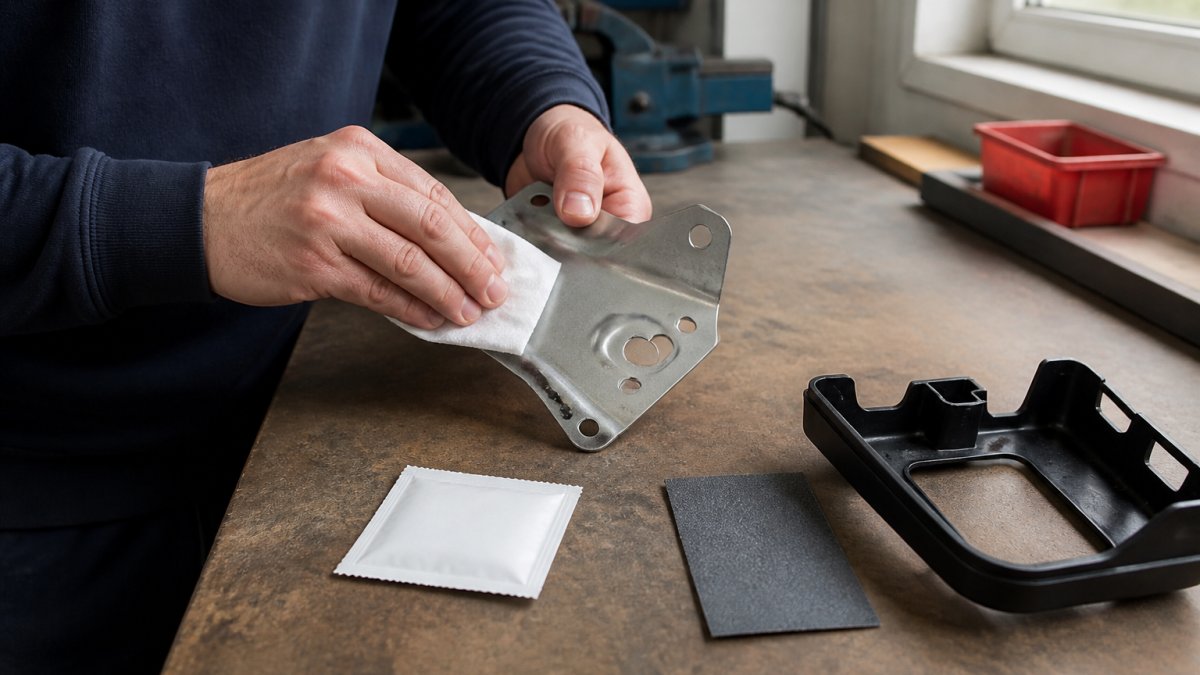
Preparing the Metal
- Degrease first. Remove oils, grease and old adhesive with a suitable cleaner. A 3M surface cleaner sachet is made for exactly this step. Wipe with a lint-free cloth and let the surface dry.
- Abrade smooth metal. Roughen the metal with fine-grit sandpaper or emery cloth so the adhesive has a key. Grit blasting works on larger parts. Aluminium and stainless steel benefit most from abrasion because their smooth surfaces offer little mechanical grip.
- Clean again. Wipe away sanding dust and let the surface dry fully. Skipping this second clean leaves dust that stops the adhesive bonding at all.
Preparing the Plastic
- Identify the plastic first. Hard plastics such as rigid PVC, ABS and polycarbonate respond well to light abrasion and standard cleaners. Low-energy plastics such as polyethylene and polypropylene resist most adhesives and usually need a specialist primer or a tape designed for low-surface-energy materials.
- Clean gently. Use a cleaner that will not attack the plastic.
- Abrade only where appropriate. A light scuff can improve grip on hard plastics, but flexible or clear plastics may mark. When in doubt, rely on a primer rather than abrasion.
- Dry-fit the parts. Check alignment before any adhesive goes on.
Applying and Joining
Apply adhesive to one surface for thin glues, or both for two-part epoxy. Follow the adhesive's open time, then clamp or press. Use enough pressure to spread the adhesive into a thin, even bond line, and do not disturb the joint during fixture time.
3M VHB DOUBLE SIDED SELF ADHESIVE TAPE ROLLS - Grey or Clear →

Watch out: using a solvent that attacks the plastic, or abrading a clear plastic that then shows marks, can ruin the part before the adhesive is even applied.
Double-Sided Tape for Plastic to Metal: When It Beats Liquid Adhesive
Double-sided tape for plastic to metal wins when both surfaces are flat, clean and the load is light to moderate. It gives instant grab with no mixing, no clamping and no cure wait.
3M VHB tape is a high-strength acrylic foam tape that flows onto the surface after application. At room temperature, roughly half its bond strength develops in 20 to 30 minutes, around 90% after 24 hours, and full strength after 48 to 72 hours. Pressure during application improves the final bond.
Tape suits signage, trim, brackets and panel fixing. It struggles on curved, textured or very small contact areas. For those, a liquid adhesive or a foam pad such as the 3M 9448A foam sticky pads is a better fit.

Application, Clamping and Cure Times Explained
Application decides whether the joint reaches its rated strength. Three timings matter:
- Open time: how long you have to position parts before the adhesive skins over.
- Fixture time: how long clamping is needed before the part holds itself.
- Full cure: when the bond reaches maximum strength, often 24 to 72 hours.
Apply adhesive to one surface for thin glues, or both for two-part epoxy. Use enough pressure to spread the adhesive into a thin, even bond line. Clamp evenly and do not disturb the joint during fixture time. Warm rooms speed curing; cold workshops slow it.
Joint Design, Load Direction and Testing Your Bond
A well-designed joint spreads stress. Adhesives handle shear and compression far better than peel. Design so the load pulls along the joint, not away from it.
- Add a lap or overlap to increase bonded area.
- Avoid peeling loads at edges, which start failures.
- Allow for different expansion rates between plastic and metal.
Test before trusting. Make a sample joint and load it in the way the real part will be loaded. If it fails, check preparation first, then the adhesive choice.
Ordering the Right Adhesive for Your Project
Match the product to the job, not the other way round. For flat, clean surfaces and light loads, a VHB tape roll is quick and strong. For gap filling and structural repairs, choose epoxy or MMA.

Before ordering, make sure the tape is genuine. Our guide on how to identify genuine 3M adhesive tape shows what to check so your bond performs as expected. Just Tape stocks 3M VHB tape rolls from £5.95 and sticky pads from £3.95, with free Royal Mail 48 shipping on UK orders over £20.
Frequently Asked Questions
What is the best adhesive for bonding plastic to metal?
There is no single answer because it depends on the plastic. A two-part epoxy suits rigid plastics and load-bearing joints, cyanoacrylate gives a fast hold on small, well-fitting parts, and MMA acrylic adhesives handle impact and mixed materials. For flat panels where drilling is not an option, a high-strength double-sided tape such as 3M VHB works well. Always check the adhesive is listed as compatible with your specific plastic before you buy.
How do you prepare plastic and metal before bonding them?
Clean both surfaces with a suitable cleaner to remove dust, grease and old adhesive, then let them dry fully. Roughen smooth metal with fine-grit sandpaper or emery cloth and wipe away the dust. Some plastics, such as polypropylene and polyethylene, need a specialist primer before any adhesive will hold. Handle the cleaned faces as little as possible so you do not transfer oils back onto them.
Can epoxy glue bond plastic to metal?
Yes, epoxy glue for plastic and metal is one of the most reliable choices for rigid parts and structural joints. It fills small gaps, resists moisture and handles load well when the joint is designed properly. Mix it exactly to the ratio on the pack, apply to both surfaces and clamp until the fixture time has passed. Note that flexible plastics and some low-energy plastics still need a primer or a different adhesive.
Why is my plastic-to-metal bond failing?
Most failures come down to three things: the wrong adhesive for the plastic type, contamination left on the surface, or load applied before the bond has cured. Grease, mould release agents and old adhesive stop the glue from gripping. Peeling loads also break bonds that would hold under shear. Clean and abrade the surfaces, match the adhesive to the material, and leave the joint undisturbed for the full cure time rather than the shorter fixture time.
Bonding plastic to metal rewards patience more than spending. Clean, abrade, match the adhesive to the plastic, and test before you commit. If you are unsure which product suits your surfaces, our team is happy to help. Get started with Just Tape and build joints that hold the first time, with genuine 3M tapes, fast dispatch and expert support on hand.
