

Velcro cable ties for home office: A buying guide
Table of Contents
- Why velcro cable ties work better than plastic ties for home offices
- Understanding reusable cable ties and how they compare
- Velcro cable tie sizes: choosing the right width and length
- Cable management under desk: practical setup strategies
- Key features to look for in quality velcro ties
- Common mistakes to avoid when using velcro cable ties
- Conclusion
- Frequently Asked Questions
Last Updated: 16 October 2026
Why velcro cable ties work better than plastic ties for home offices
Velcro cable ties are a reusable fastening solution that outperform traditional plastic ties for most home office setups. Unlike single-use plastic alternatives, velcro ties grip cables securely without adhesive residue and can be repositioned infinitely. This makes them ideal for the constantly evolving cable landscape of a modern workspace, where monitor upgrades, new peripherals, and equipment swaps are routine.
The core advantage is reusability. Plastic ties require cutting to remove, creating waste and forcing you to buy replacements. Velcro cable ties separate cleanly, wrap around a new bundle, and perform just as reliably on the hundredth use as the first. For anyone managing a home office desk where cables accumulate and shift, this flexibility saves both money and frustration over time.
At Just Tape, we stock professional-grade velcro solutions from trusted brands like VELCRO® that deliver the security you need without the mess. The VELCRO® ONE-WRAP range, for instance, combines hook and loop backing in a single double-sided strap, no adhesive required, no sticky residue left behind when you peel it away.

Cable management isn't glamorous, but poor cable organisation creates real problems: tangled wires trap dust, make troubleshooting harder, and look unprofessional during video calls. A proper system using velcro cable ties eliminates these issues entirely.
Understanding reusable cable ties and how they compare
Reusable cable ties are fastening straps made from hook-and-loop material (the same technology behind velcro). They work by wrapping around cables and adhering to themselves rather than relying on plastic teeth or adhesive backing.
The comparison between cable tie types breaks down like this:
| Cable Tie Type | Reusability | Residue | Cost Over Time | Best For |
|---|---|---|---|---|
| Plastic ties | Single use | None | High (constant replacement) | Permanent installations |
| Adhesive-backed | Single use | Often sticky | High | Temporary holds |
| Velcro cable ties | Infinite reuse | None | Low | Frequently changed setups |
| Wire clips | Limited reuse | None | Medium | Fixed cable runs |
Velcro cable ties sit in a unique middle ground. They're not the cheapest upfront option, but they eliminate replacement costs entirely. A bundle of velcro ties purchased once will manage your entire home office cable system for years, and still work perfectly when you eventually upgrade your desk or relocate.
The VELCRO® ONE-WRAP ties available through Just Tape come in two widths: 13mm and 20mm, each pre-cut to 200mm lengths. This pre-portioning makes them immediately usable without cutting, though you can trim them further if needed for tighter spaces.

Velcro cable tie sizes: choosing the right width and length
Cable bundle thickness determines which velcro cable tie size you need. Choosing incorrectly means either wasted material or insufficient holding power.
13mm width suits thin cable runs: a single USB cable, a power lead, or two network cables grouped together. This size wraps neatly around individual peripherals without bulk. Use 13mm when space is tight, under desks, behind monitors, or in cable trays where every millimetre matters.
20mm width handles thicker bundles: a monitor power cable plus USB hub cables, or a cluster of four to six wires grouped together. The extra width distributes grip force more evenly, making 20mm the safer choice for heavier loads. Most home office desks benefit from a mix of both sizes.
Length considerations matter less than width because velcro cable ties can be trimmed to fit. The standard 200mm length works for most applications, wrapping around a typical cable bundle with room to spare. For particularly tight spaces (like threading between desk legs), you can cut a 200mm tie down to 100mm or smaller without losing holding power.
A practical approach: purchase one pack of 13mm ties and one pack of 20mm ties. Test them on your existing cable bundles. You'll quickly identify which size handles your setup best, then order additional packs accordingly. Just Tape stocks both widths, so you can trial different configurations without committing to a single size.
Cable management under desk: practical setup strategies
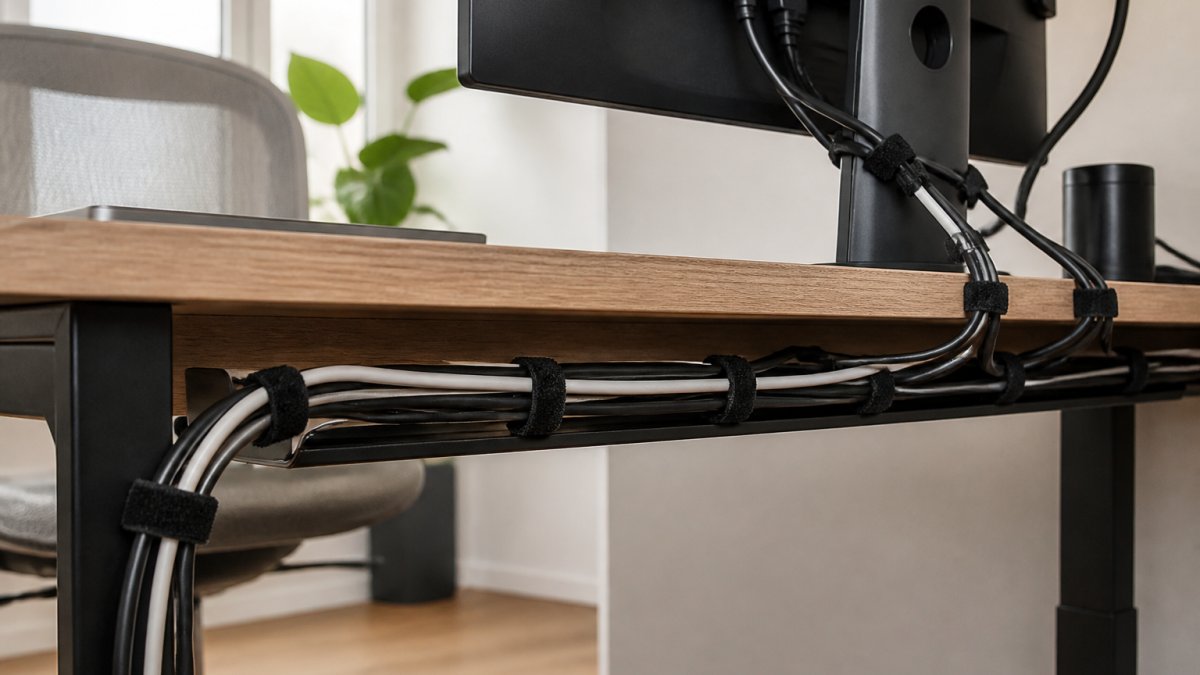
Effective cable management under a desk follows a simple principle: bundle similar cables, secure them at intervals, and keep runs away from high-traffic areas where feet or chair wheels might disturb them.
Start by identifying cable categories: power leads, network cables, USB extensions, and monitor connections. Group each category into separate bundles using velcro cable ties. This approach makes troubleshooting faster, if a monitor stops working, you know exactly which bundle to inspect.
Secure bundles at two or three points along their run. If cables travel 1.5 metres from your power strip to your desk, place ties at the 0.5-metre mark and 1-metre mark. This prevents bundles from sagging or tangling midway, which is where most cable chaos begins.
Route cables behind your desk rather than across the floor. Use adhesive clips or cable trays to guide runs along the desk underside. Velcro cable ties then secure bundles within those guides at regular intervals. This keeps cables invisible during video calls and protects them from accidental damage.
When adding a new cable to an existing bundle, unwrap the velcro tie, insert the new cable, and wrap again. No cutting, no waste, no downtime. This flexibility is why velcro cable ties outperform permanent solutions for home office environments where equipment changes are normal.
VELCRO® ONE-WRAP Reusable Double Sided Strapping Tape Hook and Loop →
Key features to look for in quality velcro ties
Not all velcro cable ties perform equally. Several features separate reliable products from disappointing ones.
Double-sided construction is essential. Single-sided ties with adhesive backing create the residue problem they're meant to solve. The VELCRO® ONE-WRAP ties use hook-and-loop material on both sides, meaning the tie adheres to itself without any adhesive layer. This is the standard you should expect.
Material durability matters for long-term reuse. Cheap velcro loses grip after 10-15 uses as the hook surface flattens. Professional-grade velcro from brands like VELCRO® maintains consistent holding power across hundreds of reuses. The difference becomes obvious after a few months of regular repositioning.
Width consistency prevents weak spots. Lower-quality ties sometimes have thinner material along the edges, creating pressure points that fail under load. Premium ties maintain uniform width and thickness throughout, distributing grip force evenly.
Colour options affect visibility and aesthetics. Black velcro cable ties blend into most office environments and hide dust accumulation better than lighter colours. If your cables run through visible areas, black ties keep the setup looking organised and professional.
Common mistakes to avoid when using velcro cable ties
Most velcro cable tie failures stem from user error rather than product defects. Avoiding these mistakes ensures reliable performance.
Wrapping too tightly is the most common error. Excessive tension compresses the hook-and-loop material, reducing its grip capacity and accelerating wear. Wrap firmly enough to prevent slipping, but not so tight that the bundle deforms. A light tug should move the bundle slightly, that's the right tension.
Mixing old and new ties in the same bundle creates weak points. If you've used a velcro tie for six months and add a new tie to the same bundle, the older tie's reduced grip becomes the limiting factor. Replace all ties in a bundle at once to maintain consistent holding power.
Ignoring cable weight leads to tie failure. A bundle containing a heavy monitor power cable plus lighter USB wires needs wider ties than a bundle of USB cables alone. Use 20mm ties for mixed bundles and 13mm ties for lightweight runs. Undersizing ties is the fastest way to watch cables slip.
Leaving ties exposed to dust gradually reduces their effectiveness. Velcro hook material traps dust particles, which fill the tiny loops and reduce grip. Periodically wipe ties with a dry cloth or gently brush them with an old toothbrush to restore surface texture. This simple maintenance extends tie life indefinitely.
Reusing damaged ties wastes time and creates frustration. If a tie's hook side has flattened or its loop side has matted, replace it. Damaged ties won't grip reliably, and you'll spend more time adjusting them than replacing them would take.
Conclusion
Velcro cable ties transform home office cable management from a recurring frustration into a solved problem. They're reusable, leave no residue, and adapt instantly to equipment changes, exactly what a modern workspace demands.
Just Tape supplies professional-grade VELCRO® ONE-WRAP ties in both 13mm and 20mm widths, starting at £3.95 for the strapping tape and £5.95 for pre-cut ties. With free Royal Mail 48 delivery on orders over £20 and dispatch within 24 hours, you can have a complete cable management system in place by the end of the week. Contact our team if you need guidance on sizing or quantities for a larger installation, we're here to help you get it right.
Frequently Asked Questions
Can you reuse velcro cable ties multiple times?
Yes. Velcro cable ties are designed for repeated use without losing grip. Unlike plastic ties that break when cut, velcro ties separate cleanly and stick back together dozens of times. Simply peel them apart when you need to reorganise your cables, then wrap and fasten again. This makes them ideal for home offices where desk layouts change or you need to add new equipment.
What size velcro cable tie do I need for desk cables?
Most desk cables work with 13mm or 20mm width velcro ties. The 13mm width suits thin cables and tight spaces under desks, whilst 20mm handles thicker bundles and provides more grip. Standard lengths of 200mm wrap around most desk cables comfortably. Measure your thickest cable bundle and choose the width that wraps around it with slight overlap, this ensures secure fastening without excessive material.
Will velcro cable ties damage my cables or equipment?
No. Velcro ties use a hook-and-loop fastening system with no adhesive, so they won't leave sticky residue or damage cable insulation. They grip without cutting into wires, making them safer than plastic ties that can pinch or crack if over-tightened. Just ensure you don't wrap them so tightly that you compress the cable bundle excessively, which could stress connectors.
How many cable ties do I need for a typical home office setup?
Most home offices need 5-10 velcro ties depending on equipment. Count your separate cable runs: monitor cables, keyboard, mouse, chargers, and desk lamps typically require 1-2 ties each. Start with a pack that gives you flexibility to group cables efficiently, then adjust based on your actual setup. Having extra ties allows you to reorganise as you add new devices without running short.