

Strongest Industrial Adhesive: What Works Best
Table of Contents
- What Is the Strongest Industrial Adhesive?
- How to Prepare Surfaces for Industrial Bonding
- Understanding Curing Time for Industrial Adhesives
- 3M VHB Double-Sided Tape: High-Strength Acrylic Bonding
- 3M Foam Adhesive Pads: Thick, Durable Fastening
- Nano Tape: Reusable, Removable Strength Without Residue
- Where to Buy Industrial Adhesive Tape Online 2026
- Frequently Asked Questions
Last Updated: September 30, 2026
What Is the Strongest Industrial Adhesive?
The strongest industrial adhesive isn't a single product, it's the right match between the adhesive type, the surfaces you're bonding, and the conditions it will face. High-performance acrylic adhesives, foam-based pads, and nano-gel tapes each deliver exceptional strength in different scenarios. Understanding what makes an adhesive "strong", whether you need permanent bonding, reusability, or resistance to temperature and vibration, is what separates a reliable fastening solution from a failed project.
At Just Tape, we provide a comprehensive range of high-quality fastening tapes, double-sided rolls, and reusable ties from trusted brands like 3M and VELCRO® Brand. The strongest industrial adhesive for your application depends on three core factors: substrate compatibility (what you're sticking to), environmental conditions (temperature, humidity, vibration), and whether you need the bond to be permanent or removable.
How to Prepare Surfaces for Industrial Bonding
Surface preparation determines whether even the strongest adhesive will hold. Dirt, dust, oils, and old residue create a barrier between the adhesive and the substrate, drastically reducing bond strength. Clean surfaces are non-negotiable.
Start by removing loose material with a dry cloth or soft brush. For oily or greasy surfaces, common on metal, machinery, or automotive parts, use a solvent wipe or isopropyl alcohol on a clean cloth. Let the surface dry completely before applying adhesive. Rough or textured surfaces bond better than smooth ones, so lightly abrading glossy surfaces with fine sandpaper (around 120-180 grit) can improve adhesion significantly.
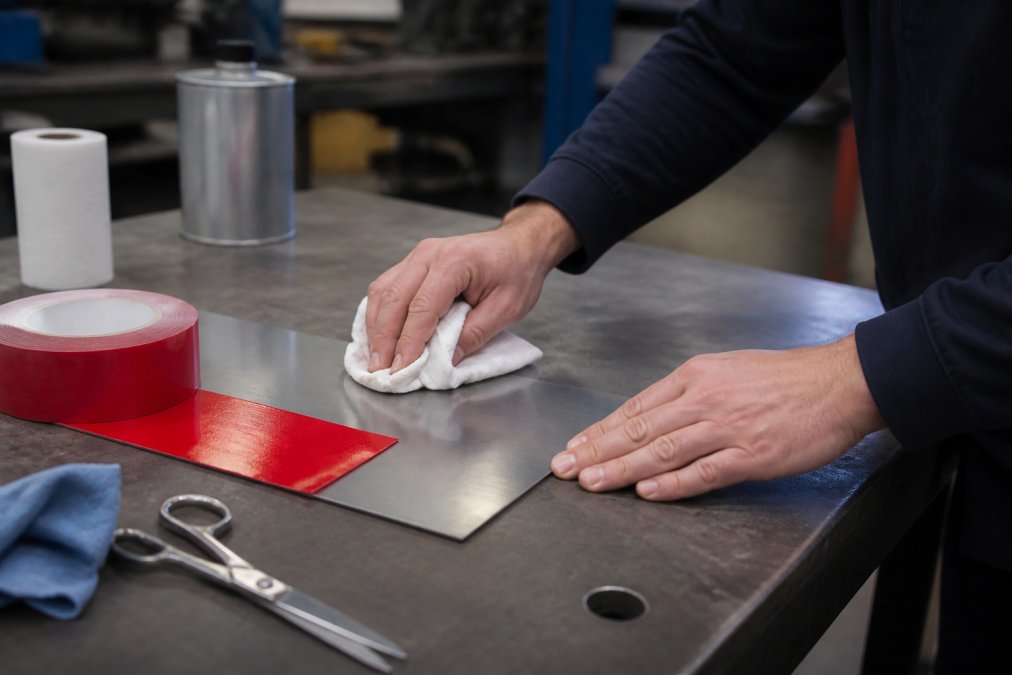
Temperature and humidity matter too. Most industrial adhesives perform best when applied at room temperature (15-25°C) with relative humidity between 30-70%. Cold, damp conditions slow curing and can trap moisture under the adhesive, weakening the bond. Allow surfaces to acclimatise to room temperature if they've been stored in cold environments.
For porous surfaces like wood or concrete, apply the adhesive to both surfaces rather than just one. This ensures the adhesive fills the micro-voids in the material. Pressure is your ally, apply firm, even pressure for at least 15 minutes after bonding. The stronger the initial contact, the faster the adhesive flows onto the surface and the quicker the bond develops.
Understanding Curing Time for Industrial Adhesives
Curing time is where patience becomes part of the strength equation. An adhesive reaches initial set, the point where it can bear light load, relatively quickly. Full strength, however, takes considerably longer.
Most high-performance industrial adhesives, including the 3M VHB range, achieve approximately 50% of their ultimate bond strength within 20-30 minutes at room temperature. This is the "safe to handle" window. Reaching 90% strength typically takes 24 hours. Full cure, the point where the adhesive has completely polymerised and reached its maximum performance, usually occurs after 48-72 hours.

This timeline isn't arbitrary. The adhesive continues to flow and wet the substrate during this period, progressively improving contact and molecular bonding. Disturbing the joint during curing, moving it, applying load, or exposing it to temperature changes, interrupts this process and compromises final strength.
Environmental factors shift these timelines. Warmer temperatures accelerate curing; cooler conditions slow it down. High humidity can also extend curing time, particularly for moisture-sensitive adhesives. If you're working in a cold warehouse or outdoor setting in winter, add 24-48 hours to your curing estimates.
For projects where speed is critical, foam-based adhesive pads can support light loads after just 15 minutes, though full strength still requires 24-48 hours.
| Adhesive Type | Initial Set | 90% Strength | Full Cure | Best For |
|---|---|---|---|---|
| 3M VHB Roll Tape | 20-30 min | 24 hours | 48-72 hours | Large surface areas, permanent bonds |
| 3M Foam Pads | 15 minutes | 24 hours | 48-72 hours | Vibration isolation, uneven surfaces |
| Nano Tape | 10 minutes | 12 hours | 24-48 hours | Temporary or repositionable bonds |
3M VHB Double-Sided Tape: High-Strength Acrylic Bonding
The 3M VHB range represents industrial-grade acrylic adhesive technology. VHB stands for "Very High Bond," and the name reflects its performance. This is the strongest industrial adhesive for applications requiring permanent bonding across large surface areas.
What makes VHB genuinely strong is the acrylic chemistry. Unlike rubber-based adhesives that lose grip over time, acrylics continue to strengthen as they cure. The adhesive is firm and dry to the touch, it won't transfer to your hands or leave residue, yet it maintains exceptional tack when pressure is applied.
VHB tape comes in rolls of 3 metres, available in grey or clear formulations. You can cut it easily with scissors, making it adaptable to various widths and lengths.
The 3M VHB Double-Sided Self Adhesive Tape Rolls are priced at £5.95 and excel on mobile phone repairs, automotive trim, signage, mirrors, and industrial equipment. The tape bonds effectively to metal, plastic, wood, laminates, and tiles, the breadth of compatibility is one reason it dominates industrial settings.
One practical advantage: pressure on the adhesive and the surface can help improve bond strength. After application, the bond strength will increase as the adhesive flows onto the surface.
3M VHB DOUBLE SIDED SELF ADHESIVE TAPE →
The limitation is permanence. VHB bonds are designed to last the life of the assembly. If you need to remove or reposition components later, you'll need heat (a hairdryer or heat gun) to soften the adhesive and separate the parts. This is rarely a problem in manufacturing, but it matters for applications where flexibility or future adjustments are priorities.
3M Foam Adhesive Pads: Thick, Durable Fastening
Where VHB tape excels on flat, rigid surfaces, foam adhesive pads solve the problem of uneven or flexible substrates. The 3mm thickness of 3M foam pads provides cushioning and conforms to surface irregularities that would defeat a flat tape.
Foam pads come in square, round, and rectangular shapes, and you can mix shapes in a single order. They're available in pack sizes from 5 to 50 pads, making them scalable for both small repairs and large industrial projects. The 3M Foam Double Sided Adhesive Sticky Pads are priced at £5.95 per pack.

The strength of foam pads comes from two sources: the adhesive itself (identical acrylic chemistry to VHB tape) and the mechanical support provided by the foam. The foam distributes pressure across a wider area, reducing stress concentration at the edges of the bond. This makes foam pads exceptionally resistant to vibration and shock, ideal for securing equipment on moving vehicles or machinery with rotating parts.
Application is straightforward. Remove a pad from the sheet, place it on the first surface, press firmly for 15 minutes, then peel off the backing and apply the second component. The 15-minute initial set window is shorter than tape because the pad's geometry provides better initial contact.
To remove, heat with a hairdryer to avoid marks or damage to walls or other surfaces.
The tradeoff is coverage. A single foam pad covers a smaller area than rolled tape, so bonding large flat surfaces requires multiple pads. For a typical number plate, 6 pads are recommended, and indeed, Just Tape offers the 6 x 3M Number Plate Sticky Pads Strips (£5.95) pre-cut and sized specifically for UK registration plates.
Nano Tape: Reusable, Removable Strength Without Residue
Nano tape represents a different philosophy: temporary or repositionable bonding without the commitment of permanent adhesives. This is the strongest industrial adhesive for applications where flexibility and reusability are requirements.

Nano tape uses a gel-based double-sided adhesive that bonds strongly to clean, smooth surfaces yet releases cleanly without residue. The material is transparent, non-toxic, environmentally friendly, and recyclable. It comes in 3-metre rolls, available in 1mm or 2mm thickness and 10mm or 20mm widths, priced at £4.95.
The strength is genuine.
Where to Buy Industrial Adhesive Tape Online 2026
Finding genuine, high-quality industrial adhesive tape online remains frustratingly difficult.
Frequently Asked Questions
What is the strongest industrial adhesive for metal-to-metal bonding?
3M VHB double-sided tape delivers high-strength acrylic adhesive suitable for metal applications. It reaches 50% bond strength within 20-30 minutes and 90% within 24 hours, with full strength achieved after 48-72 hours. For heavier metal loads, 3M foam pads (3mm thick) provide additional structural support and are designed for vehicles and automotive trim where metal-to-metal contact requires maximum hold.
How long does it take for industrial adhesives to cure fully?
Curing time for industrial adhesives varies by product type. 3M VHB tape achieves approximately 50% bond strength after 20-30 minutes at room temperature, 90% after 24 hours, and 100% after 48-72 hours. Nano tape, being a gel-based option, has an initial set within 10 minutes, 90% strength by 12 hours, and full cure by 24-48 hours. Always allow full curing time before applying heavy loads for maximum strength.
Can I remove industrial adhesive tape without damaging the surface?
Yes, removal depends on the adhesive type. Nano tape is specifically designed as removable and reusable with no residue, making it ideal for temporary applications. For 3M foam pads, heat with a hairdryer for avoiding marks or damages on wall or other surfaces during removal. Standard 3M VHB tape provides permanent bonding, so removal is not recommended if surface preservation is critical. Choose nano tape if you need flexibility to reposition.
Where can I buy industrial adhesive tape online with fast delivery?
Just Tape stocks a full range of industrial-grade adhesives from trusted brands, with items dispatched within 24 hours and free Royal Mail 48-hour shipping on orders over £20. Our catalogue includes 3M VHB tape rolls (from £5.95), foam pads (£5.95), and nano tape (£4.95). For bulk orders or hard-to-find sizes, our sourcing service can help manufacturing companies and trade professionals find exactly what they need.