

3M Adhesive Tape: Which Type Works Best?
Table of Contents
- Quick Comparison: 3M Adhesive Tape Types at a Glance
- What Makes 3M Adhesive Tape Different from Generic Rolls
- Surface Preparation for Adhesive Tape: Getting the Bond Right First Time
- 3M VHB Tape Applications: Where Structural Bonding Replaces Mechanical Fixings
- How to Remove 3M Double Sided Tape Without Damaging Surfaces
- Matching Tape to Your Project: Trade, Office and Home Scenarios
- Frequently Asked Questions
Last Updated: September 29, 2026
Quick Comparison: 3M Adhesive Tape Types at a Glance
Choosing the right 3M adhesive tape comes down to matching the tape's chemistry and thickness to your surface, load, and environment. Get that match right and the bond holds for years. Get it wrong and you will be re-sticking the same cable tray by Friday.
This guide from Just Tape breaks down the main 3M adhesive tape families, where each one belongs, and how to prepare a surface so the bond actually lasts. Below, we will show you exactly how to pick a tape by trade, office, or home project, and how to remove it without wrecking the surface underneath.
Here is the quick version before we go deeper:
| Tape Type | Bond Strength | Best For | Removable? |
|---|---|---|---|
| VHB (very high bond) | Permanent, structural | Metal, glass, signage, automotive trim | No, destructive removal |
| Double sided foam | Strong, semi-permanent | Mounting brackets, hooks, trim | Usually, with care |
| Double sided film (tissue) | Light to medium | Paper, card, light plastics | Yes |
| Surface protection | Low tack | Temporary masking, transit film | Yes |
| Cable and duct | Medium | Cable routing, bundling | Yes |
The single biggest mistake with 3M adhesive tape is buying on thickness alone. A thicker foam does not automatically mean a stronger bond. What matters is whether the adhesive chemistry suits your substrate, and whether you have cleaned that substrate properly first.
What Makes 3M Adhesive Tape Different from Generic Rolls
Most cheap tape fails for the same reason: the adhesive cannot cope with the surface energy of what it is stuck to. Low surface energy plastics such as polyethylene and polypropylene repel ordinary adhesives, so a generic roll peels within days.
3M formulates specific adhesive families for specific substrates. Acrylic adhesives handle outdoor UV and temperature swings. Rubber-based adhesives grab quickly on contact but soften in heat. Silicone adhesives suit high-temperature and low-energy surfaces.
The practical difference shows up in three places:
- Consistency: 3M tape is manufactured to a stated thickness and adhesive weight, so batch two behaves like batch one.
- Documented performance: 3M publishes technical data sheets listing peel adhesion and temperature range for each product, which lets a procurement team specify a tape rather than guess.
- Ageing behaviour: Acrylic-based 3M tapes resist yellowing and embrittlement, which matters for anything visible or long-term.
For trade buyers, that documentation is the real value. You can hand a specifier a data sheet instead of a sample roll and a shrug.
Surface Preparation for Adhesive Tape: Getting the Bond Right First Time
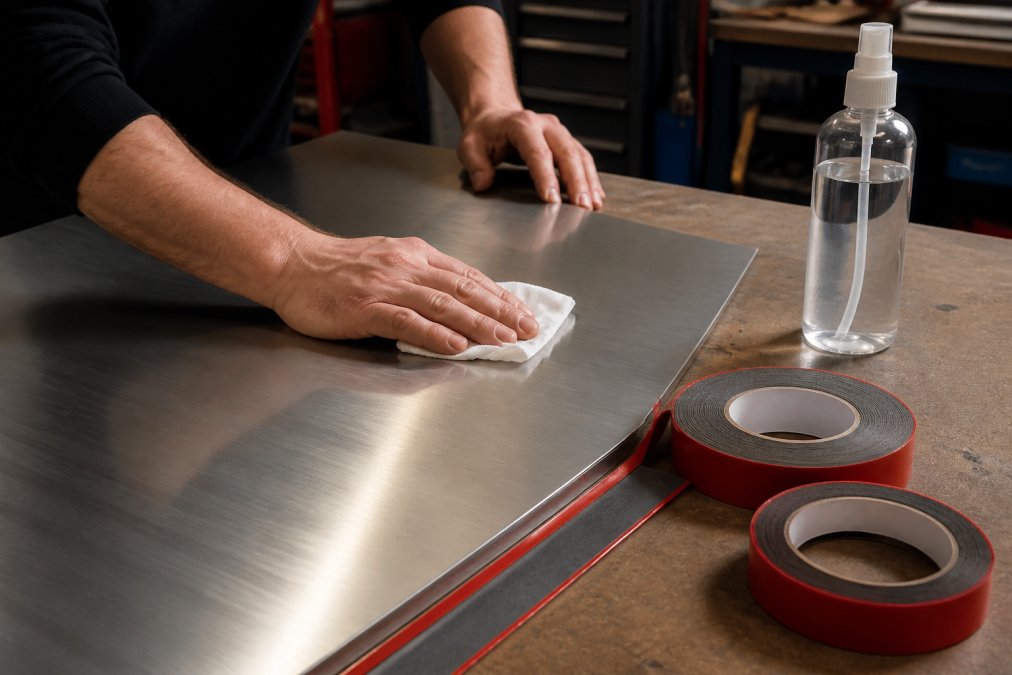
Surface preparation for adhesive tape is the step that decides whether the bond lasts or fails. Most adhesion failures are contamination failures, not tape failures. Dust, oil, silicone polish, and even fingerprints sit between the adhesive and the substrate and stop the bond forming.
The routine is simple and takes minutes:
- Wipe the surface with a lint-free cloth and isopropyl alcohol.
- Let it flash off completely. Do not wipe dry with a paper towel, which leaves fibres behind.
- Apply firm, even pressure across the whole tape face, ideally with a roller.
- Wait before loading the joint. Acrylic adhesives build strength over hours, not seconds.
Pressure matters more than most people expect. Adhesive needs to flow into the microscopic texture of the surface. A quick thumb press leaves air pockets and contact only at the high points.
Cleaning and Priming Different Substrates
Different materials need different handling. Metal and glass are straightforward: degrease, dry, apply. Painted surfaces need a gentler approach because aggressive solvents can dull or lift the paint. Wipe with a mild detergent solution, rinse, and dry fully.
Plastics are where preparation earns its keep. Low surface energy plastics often need a primer before tape will hold. A primer is a thin liquid that changes the surface chemistry so the adhesive can grip. Without it, tape on polyethylene or polypropylene will release under load.
Porous surfaces such as bare timber and concrete are a different problem again. They absorb adhesive and leave little to bond to, so a primer or a higher-adhesive-mass tape is usually required.
3M VHB Tape Applications: Where Structural Bonding Replaces Mechanical Fixings
3M VHB tape applications are where adhesive stops being a convenience and starts replacing rivets, screws, and welds. VHB stands for very high bond, and it is a closed-cell acrylic foam that forms a permanent structural joint.
It works because the foam core distributes stress across the whole bonded area rather than concentrating it at a fixing point. That means no drilled holes, no corrosion points, and no thermal bridging through a metal fastener.
Where it makes sense:
- Bonding metal panels to frames where drilling would weaken the section
- Attaching trim and badges where a visible fixing would spoil the finish
- Sealing and bonding in one step on curtain wall and cladding details
- Mounting signage where the rear face must stay clean
VHB is not a gap-filler for badly fitting parts, and it is not reversible. Treat any VHB joint as permanent and design accordingly.
Automotive, Signage and Construction Use Cases
In automotive work, VHB bonds trim strips, spoilers, and body mouldings, and it copes with vibration and temperature cycling that would shake a mechanical fixing loose. In signage, it holds aluminium composite panels to subframes without visible fasteners. On site, it bonds cladding and glazing components where a mechanical fixing would puncture a weather seal.
The common thread is a joint that needs to be strong, weather-resistant, and invisible. Where any of those three does not apply, a simpler tape will usually do the job for less money.
How to Remove 3M Double Sided Tape Without Damaging Surfaces
Removing 3M double sided tape safely means softening the adhesive before you pull, not ripping it off cold. Heat is your main tool. A hairdryer on a low setting or a heat gun held well back will soften most acrylic and rubber adhesives enough to release their grip.
Work through it in this order:
- Warm the tape until it feels slightly pliable, not hot.
- Slide a plastic scraper or an old credit card under one edge.
- Peel back slowly at a shallow angle, keeping tension low.
- Use isopropyl alcohol or a citrus-based adhesive remover on any residue.
- Wipe clean and let the surface dry before re-taping.
Never use a metal scraper on painted or coated surfaces. The scratch you create will cost more to fix than the tape ever did.
For stubborn VHB removal, the accepted method is to cut the foam core with a length of fishing line or dental floss worked behind the bond, then remove the residue with a rubber wheel on a drill at low speed. Take your time. Impatience is what damages surfaces.
Matching Tape to Your Project: Trade, Office and Home Scenarios
Matching tape to the job is faster than trial and error, and it saves you buying three rolls to find the one that works. Start with the substrate, then the load, then the environment.
Trade and manufacturing: Specify by data sheet. For structural joints on metal or composite, VHB. For temporary holding during assembly, a surface protection tape that peels clean. For bundling cables and hoses, a cable tape rated for the temperature of the installation.
Office and IT: Cable management is the main job. Low-profile double sided tape holds cable trunking and clips to desks and walls without drilling.
Frequently Asked Questions
Which 3M adhesive tape is strongest for heavy-duty mounting?
3M VHB (Very High Bond) tape delivers the strongest hold for permanent mounting of metal, glass and composite panels. It bonds with a foam core that absorbs vibration and thermal movement, so it handles loads that standard double-sided tape cannot. For lighter jobs, such as hanging a small picture hook, a thin double-sided tape is sufficient. Match the tape to the weight and surface before you buy.
Is 3M VHB tape permanent?
In most applications, yes. VHB tape forms a permanent structural bond once it has fully cured, which takes around 24 to 72 hours depending on temperature. It resists moisture, UV light and temperature swings, so it holds for years outdoors and indoors. Removing it later is possible with heat and a suitable solvent, but expect some effort. If you need a reversible fixing, choose a removable foam tape instead.
How do I remove 3M adhesive tape without damaging surfaces?
Warm the tape with a hairdryer on a low setting for 30 to 60 seconds to soften the adhesive, then peel slowly at a shallow angle. For residue, apply isopropyl alcohol or a citrus-based cleaner and wipe with a lint-free cloth. On painted walls, work gently to avoid lifting the paint. A plastic scraper helps on glass and metal. Never use a metal blade on soft surfaces.
Does 3M adhesive tape work on brick or masonry?
It can, but the surface must be sealed, dry and free of dust. Bare brick and mortar are porous and uneven, so standard double-sided tape will not grip reliably. Apply a masonry primer or sealer first, let it cure fully, then use a high-bond foam tape such as VHB. For very rough surfaces, a mechanical fixing is the safer choice. Always test a small area before committing to a full installation.
Sorting your tape by substrate, load, and environment takes ten minutes and saves a wasted weekend of re-sticking. Just Tape supplies genuine 3M adhesive tape and VELCRO® Brand products with fast dispatch, free Royal Mail 48 shipping on orders over £20, and a sourcing service for specifications that are hard to find. Get started with Just Tape and get the right tape the first time.